
News
For all media inquiries and opportunities, please contact our Public Relations Team
Celebrating a Win for the Florida Wildlife Corridor – and Florida’s Conservation Future
Currently, Conservation Florida is the only Florida land trust working statewide to protect land within the Florida Wildlife Corridor by developing strategies, exploring funding sources and purchasing or accepting donations of land and conservation easements.
From the Florida Panhandle to the Florida Keys, Conservation Florida’s ongoing efforts are successfully shaping our state’s future and preserving some of the rarest habitats and species in the world.
In July 2021, we celebrated a major milestone when Florida Governor Ron DeSantis signed the Florida Wildlife Corridor Act into law. A vital and vibrant part of Florida’s ecological landscape, the Corridor forms a greenway across the state that connects the Florida Everglades to the Panhandle and encompasses a mosaic of natural habitats.
Florida Wildlife Corridor map by: Archbold Biological Station. By A. Meeks
Currently, Conservation Florida is the only Florida land conservancy working statewide to protect land within the Corridor by developing strategies, exploring funding sources and purchasing or accepting donations of land and conservation easements. “The signing marks a big win for land conservation in Florida and sparks both excitement and inspiration for Florida’s conservation future,” said Traci Deen, Conservation Florida’s CEO.
“The Florida Wildlife Corridor provides a vision for Florida as a whole that protects the places we all love, offers habitat and room to roam for our native species, cleans and stores water, provides ample outdoor recreational opportunity, and supports Florida’s family farms and ranches, all while accounting for Florida’s future growth,” she added.
Conservation Florida has been working on connecting key segments of the Florida Wildlife Corridor since its founding in 1999. Together with its incredible partners and supporters, Conservation Florida is now actively leading the charge to protect over 100,000 acres. We look forward to working with the State of Florida to achieve continued success within the Florida Wildlife Corridor.
The Florida Wildlife Corridor Act includes many ambitious conservation goals.
Maintain wildlife access to the habitats for migration and genetic exchange amongst regional wildlife populations.
Prevent fragmentation of wildlife habitats.
Protect the headwaters of major watersheds, including the Everglades and the St. Johns River.
Provide ecological connectivity of lands needed for large-scale ecosystem functions, such as water and prescribed burns that are essential for land management and restoration.
Preserve and protect land and waters that are not only vital to wildlife, but also critical to the state’s groundwater recharge and serve as watersheds that provide drinking water to most Floridians as well as help maintain the health of downstream coastal estuaries.
Provide crossings for the protection and safety of wildlife and the traveling public.
Help to sustain Florida’s working ranches, farms, and forests that provide compatible wildlife habitat while sustaining rural prosperity and agricultural production.
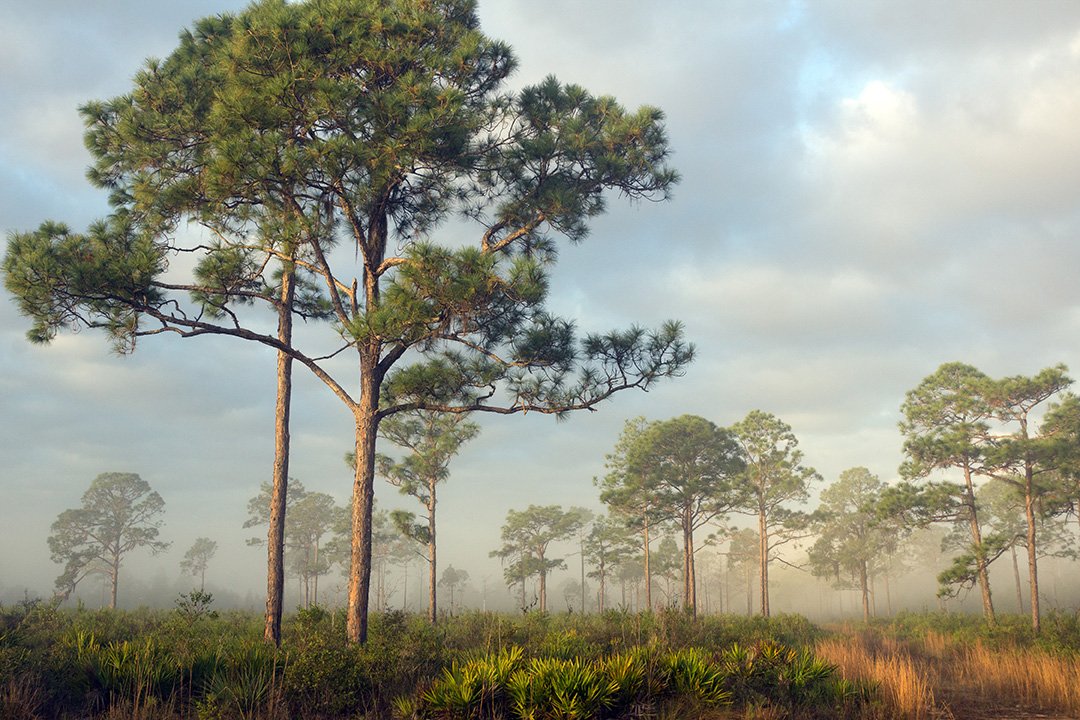
Photo by Larry Richardson.
The scrub-jay and Florida panther, two local protected species. Photo by Adam Bass.
Cowboys on a ranch farm herding cattle. Photo by Adam Bass.
Conservation Florida Secures Time to Protect Lake Marion Preserve Thanks to a Conservation Buyer
Lake Marion Preserve contains federally listed and state listed flora and fauna species including a rare habitat known as Rosemary Scrub. As habitat management is undertaken on the Preserve, the area is anticipated to increase its’ listed species utilization.
A friend of Florida, who wishes to remain anonymous, worked with Conservation Florida to outbid a developer and purchase 700+ acres on Lake Marion in Polk County.
Haines City, Fla. (July 27, 2021) – Conservation Florida, a dynamic driver of statewide land conservation and partner in the protection of the Florida Wildlife Corridor, announced today the temporary protection of Lake Marion Preserve. The group plans to permanently protect the land with Polk County, US Fish and Wildlife, and other partners.
“Working with a conservation buyer allowed us to move quickly to get this high-priority property off the market,” said Adam Bass, Conservation Florida’s director of conservation. “There were competing bids from developers, but now we have time to pull together funding for its permanent protection.”
The significance of its location cannot be overstated. Lake Marion Preserve falls within the boundaries of Conservation Florida’s Headwaters to Okeechobee (H2O) Initiative and within the Florida Wildlife Corridor. It is also within the Avon Park Air Force Range’s Sentinel Landscape and adjacent to other protected land.
Once permanently protected, it will expand on current conservation lands within the Florida Wildlife Corridor that cover more than 3,000 acres from Catfish Creek Preserve to Lake Wales Ridge State Forest.
The Florida Wildlife Corridor is a geographic boundary based on decades of scientific research. But it is more than lines on a map. It is a statewide vision for Florida’s conservation lands that addresses the need for landscape-scale conservation approaches, and specifically corridors, to save land critical to the survival of Florida species.
Lake Marion Preserve contains federally listed and state listed flora and fauna species including a rare habitat known as Rosemary Scrub. As habitat management is undertaken on the Preserve, the area is anticipated to increase its’ listed species utilization.
Rosemary scrub habitat, also called rosemary bald, is a relatively open landscape characterized by large Florida Rosemary shrubs (Ceratiola ericoides). While it is locally common in Highlands County and a few other regions of Florida, Florida Rosemary is still under threat from habitat destruction and degradation. The threatened sand skink is found primarily in the rosemary scrub habitat of Central Florida. Photo by Adam Bass.
Due to the overgrown habitat conditions, no Florida Scrub-Jays are currently within the Preserve; however, the adjacent managed public land supports several family groups. The Scrub-Jay Recovery Team identified this property as important to the future of the Florida Scrub-Jay because it contains habitat needed by the birds to increase the number of family groups in the area. With proper management the preserve is anticipated to provide additional habitat not just for Florida Scrub-Jays but for a suite of species.
The Florida Scrub Jay is the only bird species endemic to Florida, meaning its found nowhere else in the world. It inhabits sand pine and xeric oak scrub, and scrubby flatwoods. It is listed as a threatened species because of loss, fragmentation, and degradation of scrub habitats throughout Florida, due primarily to urbanization, agriculture, and fire suppression. Prescribed burning is an essential element to conserving the Florida Scrub-Jay. Photo by Adam Bass.
“The bigger the population, the better for the species, said Todd Mecklenborg, the Service’s species lead recovery biologist for the Florida Scrub-Jay. As a member of the Florida Scrub-Jay Recovery Team, I believe this property will increase the carrying capacity for the Lake Wales Ridge genetic unit, which means a more resilient and robust population of Florida Scrub-Jays in the area.”
Sand skinks are another threatened species that would benefit from protection and restoration of the habitat at Lake Marion Preserve. “Sand skinks are endemic to xeric habitats found along Central Florida sand ridges, and remnants of ancient coastal dunes created during events when sea levels rose and fell. These habitats include rosemary scrub, scrubby flatwoods, sand pine and oak scrubs, and turkey oak ridge,” according to the Florida Natural Areas Inventory. The Florida sand skink is found only in seven Central Florida counties: Osceola, Polk, Lake, Highlands, Putnam, Orange, and Marion.
With over 400 acres of xeric scrub habitat and over 3 miles of shoreline on Lake Marion, it is critical that partners find the funding to repay the conservation buyer and bring the ownership of the property into public hands.
Conservation Florida and its partners have secured partial funding and are working to sort out the details of ownership and management of the land, but eventually, the partners envision the land as a public park with the addition of a conservation easement held by Conservation Florida
Help Conservation Florida save more land and keep Florida wildly beautiful by making a donation today!
About Conservation Florida
Conservation Florida is a statewide accredited land trust with a mission to save Florida’s natural and agricultural landscapes for future generations. Our conservation projects support Florida’s native plants and wildlife, fresh water, conservation corridors, family farms and ranches, the economy and nature-based recreation. Since our founding in 1999, Conservation Florida has led the way in strategic and evidence-based land protection and has saved over 30,000 acres of critical habitat through acquisition, facilitation and incubation of conservation projects.
We save land by developing conservation strategies, exploring funding sources and purchasing or accepting donations of land and conservation easements. Our other services include providing expertise to guide landowners through the land protection process, serving as a trusted community partner to support statewide land conservation and promoting land conservation through effective education and advocacy. Our vision is large-scale, and we are 100% committed to conservation in the state of Florida – for nature, for people, forever!
About Polk County
Polk County is a leading contributor to the state’s economy and politics. While citrus, cattle, agriculture and the phosphate industry still play vital roles in the local economy, an increased focus on the quickly expanding high-tech I-4 corridor has taken hold. The county’s location between both the Tampa and Orlando metropolitan areas has aided in the development and growth of the area. Residents and visitors alike are drawn to the unique character of the county’s numerous heritage sites and cultural venues, tourism attractions, stunning natural landscapes, and many outdoor activities, making Polk the heart of Central Florida.
About USFWS
The U.S. Fish and Wildlife Service is the premier government agency dedicated to the conservation, protection, and enhancement of fish, wildlife and plants, and their habitats. We are the only agency in the federal government whose primary responsibility is the conservation and management of these important natural resources for the American public.
The Service's origins date back to 1871 when Congress established the U.S. Fish Commission to study the decrease in the nation’s food fishes and recommend ways to reverse that decline. (More on our history below.) Today, we are a diverse and largely decentralized organization, employing about 8,000 dedicated professionals working out of facilities across the country, including a headquarters office in Falls Church, Virginia, and eight regional offices representing the 12 Unified Interior Regions.
Conservation Florida Secures Funding For a Ranch in the Heart of the Florida Wildlife Corridor
Conservation Florida and its partners at USDA’s Natural Resource Conservation Service (NRCS) are working to protect a 1,009-acre working cattle ranch in Highlands County.
Conservation Florida and its partners at USDA’s Natural Resources Conservation Service (NRCS) are working to protect a 1,009-acre working cattle ranch in Highlands County.
Lake Placid, Fla. (July 15, 2021) – Conservation Florida, a dynamic driver of statewide land conservation and partner in the protection of the Florida Wildlife Corridor, is one step closer to acquiring a 1,009-acre conservation easement in Highlands County thanks to the power of partnerships.
Thanks to NRCS Florida’s Agricultural Conservation Easement Program for Agricultural Land Easements Grasslands of Special Significance (ACEP-ALE-GSS) program, Conservation Florida has secured nearly $2 million to protect AP Ranch, which lies in a strategic location next to other protected lands. Identified as a critical linkage, this property is among the Florida Ecological Greenways Network’s highest priorities, and once protected, will build upon an unbroken chain of conservation properties within the Florida Wildlife Corridor.
Conservation Florida placed the property under contract to protect the land in April. Three months later it is working with partners to complete the purchase of a conservation easement, which will protect the property’s natural and agricultural landscapes.
Protecting these vast landscapes is important for water storage and filtration, native grasslands and plant communities, and for species that require a lot of room to roam, such as Florida black bears which have been seen on the property. These wide-ranging species are dependent on the conservation of connected natural lands for their survival.
The protection of AP Ranch will add 1,009 acres of critical conservation land to the Florida Wildlife Corridor, a statewide ecological greenway connecting the Everglades to the Panhandle. This will ultimately provide wildlife with access to safe passageways between conservation areas throughout the state.
“Primarily composed of native range, longleaf pine flatwoods, cutthroat seep and wetlands, this unbelievable ranch is home to an abundance of documented native and endangered wildlife,” said Adam Bass, Conservation Florida’s director of conservation. “Florida panthers, black bears, gopher tortoises, and rare grasses found only in Florida...this property’s protection will be a home run. We’re pleased and honored to work with this landowner to meet their conservation goals,” said Bass. “That’s what Conservation Florida is here for. We’re looking forward to protecting this piece of wild Florida together with the landowner and our partners.”
The ranch is also located within the boundaries of Conservation Florida’s H2O: Headwaters to Okeechobee initiative, a land conservation initiative that’s all about water in the Northern Everglades. This vital and vibrant landscape contains historic cattle ranches, sweeping vistas, and thriving ecosystems.
The map above shows AP Ranch’s connection to other protected lands.
In addition to being a working family ranch, this outstanding property contains a mosaic of natural habitats. Towering longleaf pine covers swaths of wire grass and saw palmettos. The area’s dominating flatwoods intertwine with native grasses and rare plant species to create a classic example of Florida’s natural beauty.
During a site visit to the property, the Conservation Florida team documented cutthroat grass communities. The protection of cutthroat grass is important because this species of grass is only found in five Florida counties. Not only does this native grass contribute to the integrity of Florida’s natural ecosystems, but it also provides a home to important species such as the federally threatened Eastern indigo snake.
The property’s multitude of habitats provide shelter for several state and federally threatened species such as the Florida scrub jay and the Florida panther. Iconic, and quickly disappearing species such as these, rely on the continued protection of conservation lands for their survival.
At a time when Florida’s last, large ranchlands are under intense development pressures, Conservation Florida has made ranchlands in the Northern Everglades a top protection priority.
The U.S. Dept. of Agriculture’s Natural Resources Conservation Service (NRCS) has awarded Conservation Florida a grant to protect this important property via its Grasslands of Special Significance program.
“Conservation of this property provides numerous ecological and economic benefits in this area. Having partners like Conservation Florida is essential to preserving Florida’s natural spaces,” said Juan Hernandez, Florida State Conservationist for USDA’s Natural Resources Conservation Service.
The NRCS administers the ACEP-ALE-GSS, which provides financial and technical assistance to help conserve agricultural lands and wetlands and their related benefits.
Help Conservation Florida save more land and keep Florida wildly beautiful by making a donation today!
About Conservation Florida
Conservation Florida is a statewide accredited land trust with a mission to save Florida’s natural and agricultural landscapes for future generations. Our conservation projects support Florida’s native plants and wildlife, fresh water, conservation corridors, family farms and ranches, the economy and nature-based recreation. Since our founding in 1999, Conservation Florida has led the way in strategic and evidence-based land protection and has saved over 30,000 acres of critical habitat through acquisition, facilitation and incubation of conservation projects.
We save land by developing conservation strategies, exploring funding sources and purchasing or accepting donations of land and conservation easements. Our other services include providing expertise to guide landowners through the land protection process, serving as a trusted community partner to support statewide land conservation and promoting land conservation through effective education and advocacy. Our vision is large-scale, and we are 100% committed to conservation in the state of Florida – for nature, for people, forever!
About NRCS
NRCS puts more than 80 years of experience to work assisting America's private landowners with conserving their soil, water and other natural resources. Local, state and federal agencies and policymakers also rely on our expertise. We deliver technical assistance based on sound science and suited to a customer's specific needs. Cost shares and financial incentives are available in some cases. The majority of conservation application is accomplished with local partners. Our partnership with local conservation districts serves almost every county in Florida. Participation in NRCS programs is voluntary.
Conservation Florida Wins Full Funding for Arbuckle Creek Ranch
Conservation Florida and its partners at Avon Park Air Force Range and NRCS have successfully secured funding to save the 1,250-acre Arbuckle Creek Ranch. The land will protect vital wildlife habitat, including Florida’s endangered cutthroat grass, and help sustain military readiness activities.
Arbuckle Creek winds its way through Highlands County toward Lake Okeechobee. Photo by Graham Norman.
Conservation Florida and its partners at Avon Park Air Force Range and NRCS have successfully secured funding to save the 1,250-acre Arbuckle Creek Ranch. The land will protect vital wildlife habitat, including Florida’s endangered cutthroat grass, and help sustain military readiness activities.
Avon Park, Fla., (June 15, 2021) — Conservation Florida, a dynamic driver of statewide land conservation, is moving quickly to protect 1,250 acres in Highlands County.
This will be one of many conservation lands to be permanently protected by Conservation Florida within its Headwaters to Okeechobee (H2O) regional partnership boundary. The H2O is a land conservation initiative that’s all about water in the Northern Everglades. This vibrant landscape contains historic cattle ranches, sweeping vistas, and vast ecosystems. Because it forms the headwaters of the Greater Everglades, its protection is critical for the future of Florida’s freshwater supply.
The owners of Arbuckle Creek Ranch signed an agreement with Conservation Florida in mid 2020 that gave the nonprofit time to seek funding to purchase a conservation easement, which is a binding legal agreement that permanently restricts development activities on environmentally sensitive lands.
A cowboy rides out on a foggy morning to tend cattle on Arbuckle Creek Ranch. Photo by Carlton Ward, Jr.
Conservation Florida achieved its fundraising goal through competitive federal grant programs and is now finalizing plans to permanently protect the land’s special attributes.
Arbuckle Creek Ranch is important to protect and beneficial to the public because it helps filter and replenish drinking water within the Lake Istokpoga watershed, which drains into the Kissimmee River and on to Lake Okeechobee. It also supports local agriculture, aids military readiness, and provides habitat for native plants and wildlife.
The ranch is within the boundaries of the Avon Park Air Force Range (APAFR) Sentinel Landscape. This vast landscape is centered around the Air Force’s “largest primary air-to-ground training range east of the Mississippi River,” according to APAFR.
“The protection benefits of Arbuckle Creek Ranch extend well beyond its boundaries,” said Traci Deen, Conservation Florida’s CEO. “It contributes to the health of the entire Greater Everglades Ecosystem and adds to the Florida Wildlife Corridor.”
Last year, the U.S. Dept. of Defense, through its Readiness and Environmental Protection Integration (REPI) Program, pledged over $1.7 million to support Conservation Florida’s campaign to protect Arbuckle Creek Ranch.
Now, the U.S. Dept. of Agriculture’s Natural Resources Conservation Service (NRCS) has awarded Conservation Florida and its regional partners the remaining funds needed to carry Arbuckle Creek Ranch over the finish line and protect this special property forever.
“When private landowners, nonprofits, and agencies work together, we can protect critical ranch lands within the Avon Park Air Force Range Sentinel Landscape. Partnerships such as this one are helping to keep the ranching industry viable in Florida while protecting threatened ecosystems and wildlife,” said Juan Hernandez, NRCS state conservationist for Florida.
The NRCS administers the Agricultural Conservation Easement Program for Agricultural Land Easements (ACEP-ALE), which provides financial and technical assistance to help conserve agricultural lands and wetlands and their related benefits.
In addition to the water, wildlife, and habitat benefits, protection of Arbuckle Creek Ranch will benefit Avon Park Air Force Range by reducing residential development that interferes with military operations.
“We are extremely grateful to NRCS for their support and are pleased to see this project move forward. Working in conjunction with NRCS and Conservation Florida to acquire a conservation easement on Arbuckle Creek Ranch is a tremendous opportunity to protect working lands, promote conservation, and enhance mission sustainability at Avon Park Air Force Range,” said Buck MacLaughlin, Lt. Col., Ret. AF. “Protecting this property buffers the flight path into Arbuckle Airfield and protects night-time military training by limiting dense construction of incompatible light sources. The ability to operate at night is a distinct advantage that our military forces use while serving our country.”
“Arbuckle Creek Ranch is an exceptional property,” said Adam Bass, Conservation Florida’s director of conservation. “It will protect a mile of natural land along Arbuckle Creek, two pristine streams, rangelands that are part of Highland County’s cultural heritage, and hundreds of acres of critical habitat.”
At a time when Florida is facing intense development pressures, ranchlands are sought after for conversion into large housing developments and planned communities. Conservation Florida has made ranchlands in the Northern Everglades a top protection priority within its Headwaters to Okeechobee regional land and water conservation initiative.
Arbuckle Creek Ranch is a family-run cow-calf operation where a herd of cattle is managed with the goal of raising calves to sell. It is also home to an endangered cutthroat grass community that spans 300 hundred acres.
The natural habitat on the property is also ideal for Florida scrub jays, eastern indigo snakes, and gopher tortoises. Florida panthers, and other endangered Florida species, have been documented on the ranch.
The Arbuckle Creek Ranch conservation easement project is one of many that Conservation Florida is working on in the Greater Everglades ecosystem. The larger goal of the regional initiative is to form a continuous conservation corridor stretching from the Everglades Headwaters to Lake Okeechobee.
Help Conservation Florida save more land and keep Florida wildly beautiful by making a donation today!
About Conservation Florida
Conservation Florida is a statewide accredited land trust with a mission to save Florida’s natural and agricultural landscapes for future generations. Our conservation projects support Florida’s native plants and wildlife, fresh water, conservation corridors, family farms and ranches, the economy and nature-based recreation. Since our founding in 1999, Conservation Florida has led the way in strategic and evidence-based land protection and has saved over 30,000 acres of critical habitat through acquisition, facilitation and incubation of conservation projects.
We save land by developing conservation strategies, exploring funding sources and purchasing or accepting donations of land and conservation easements. Our other services include providing expertise to guide landowners through the land protection process, serving as a trusted community partner to support statewide land conservation and promoting land conservation through effective education and advocacy. Our vision is large-scale, and we are 100% committed to conservation in the state of Florida – for nature, for people, forever!
About NRCS
NRCS puts more than 80 years of experience to work assisting America's private landowners with conserving their soil, water and other natural resources. Local, state and federal agencies and policymakers also rely on our expertise. We deliver technical assistance based on sound science and suited to a customer's specific needs. Cost shares and financial incentives are available in some cases. The majority of conservation application is accomplished with local partners. Our partnership with local conservation districts serves almost every county in Florida. Participation in NRCS programs is voluntary.
About Avon Park Air Force Range
Avon Park Air Force Range is a 106,000-acre military training facility located in Polk and Highlands Counties, in South-Central Florida (see our official mission statement). The Fish, Wildlife, and Outdoor Recreation Program works in coordination with the Air Force to provide recreational opportunities to the public and military personnel.
APAFR is known as a world-class destination for hunting, fishing, camping, hiking, birding, and outdoor educational opportunities for all ages.
Conservation Florida Working to Protect Ranch in Florida Wildlife Corridor
Conservation Florida has entered into a contract to buy a conservation easement on a 1000-acre working cattle ranch and critical piece of the Florida Wildlife Corridor in Highlands County.
Conservation Florida announces another piece of wild Florida under contract for conservation
LAKE PLACID, Fla., April 28, 2021 - Conservation Florida, a dynamic driver of statewide land conservation and partner in the protection of the Florida Wildlife Corridor, has entered into a contract to buy a conservation easement on a 1000-acre working cattle ranch in Highlands County.
The ranch is located within the boundaries of Conservation Florida’s H2O: Headwaters to Okeechobee initiative, a land conservation initiative that’s all about water in the Northern Everglades. This vital and vibrant landscape contains historic cattle ranches, sweeping vistas, and critical ecosystems. Because it forms the headwaters of the Greater Everglades, its protection is vital for the future of Florida’s freshwater supply.
More, the property sits as a critical piece of the Florida Wildlife Corridor, a statewide ecological greenway connecting the Everglades to the Panhandle.
This incredible property encompasses a mosaic of natural habitats. Towering longleaf pine covers swaths of wire grass and saw palmettos. The area’s dominating flatwoods intertwine with native grasses and rare plant species to create a classic example of Florida’s natural complexity.
“Primarily composed of native range, longleaf pine flatwoods, cutthroat seep and wetlands, this unbelievable ranch is home to an abundance of documented native and endangered wildlife,” said Adam Bass, Conservation Florida’s director of conservation. “Florida panthers, black bears, gopher tortoises, and rare grasses found only in Florida...this property’s protection will be a home run.”
At a time when Florida’s last, large ranchlands are under intense development pressures, Conservation Florida has made ranchlands in the Northern Everglades and the Florida Wildlife Corridor a top protection priority.
The property is another Conservation Florida project that exemplifies the trend of multi-purpose land conservation. The organization uses this strategy to protect land that meets many needs including agricultural production, water quality, rare and endangered species protection, and other factors – like habitat connectivity and building a statewide wildlife corridor.
“The protection benefits of this ranch will extend well beyond its boundaries. We know that the long-term health of the entire Greater Everglades Ecosystem and the protection of the Florida Wildlife Corridor hinges on conserving lands like these,” said Traci Deen, CEO of Conservation Florida.
With the property under contract, Conservation Florida and its partners are seeking grants and donations to help buy a conservation easement, which is a binding legal agreement that permanently protects the conservation values of the land.
"We’re pleased and honored to work with this landowner to meet their conservation goals,” said Bass. “That’s what Conservation Florida is here for. We’re looking forward to protecting this piece of wild Florida together with the landowner and our partners.”
About Conservation Florida
Conservation Florida is a statewide accredited land trust with a mission to save Florida’s natural and agricultural landscapes for future generations. Our conservation projects support Florida’s native plants and wildlife, fresh water, conservation corridors, family farms and ranches, the economy and nature-based recreation. Since our founding in 1999, Conservation Florida has led the way in strategic and evidence-based land protection and has saved over 30,000 acres of critical habitat through acquisition, facilitation and incubation of conservation projects.
We save land by developing conservation strategies, exploring funding sources and purchasing or accepting donations of land and conservation easements. Our other services include providing expertise to guide landowners through the land protection process, serving as a trusted community partner to support statewide land conservation and promoting land conservation through effective education and advocacy. Our vision is large-scale, and we are 100% committed to conservation in the state of Florida – for nature, for people, forever!
Conservation Florida's Eagle Haven Project Takes Big Step Forward
In 2020, Conservation Florida and the Avon Park Air Force Range formalized a partnership that has accelerated the pace of land protection in the Northern Everglades. Through its REPI program, Avon Park Air Force Range has pledged $1.6 million in funding toward the purchase of a conservation easement on Lost Oak.
Thanks to strong partnerships, partial funding has been secured to protect Eagle Haven, a 2,909-acre property on Lake Kissimmee
About the H2O: Headwaters to Okeechobee Initiative: Our current work in this region will protect thousands of acres of family-run ranches and wild landscapes, which will provide significant habitat for Florida panthers and many other critical species like the grasshopper sparrow. Read more.
LAKE WALES, Florida (March 3, 2021) — Conservation Florida, a leader in statewide land conservation, and its partners at Avon Park Air Force Range, have secured partial funding to protect land within the Avon Park Sentinel Landscape, which contains some of Florida’s most thriving ecosystems. Thanks to the Readiness Environmental Protection Integration (REPI) program, the Eagle Haven property (formerly named Lost Oak) is one step closer to permanent protection.
Eagle Haven is an ecological gem in Florida, spanning four miles of Lake Kissimmee shoreline. It contains six different habitats brimming with life. From bald eagles to otters, Eagle Haven provides critical habitat for roughly 200 species, including the beloved Florida scrub-jay. 300-year-old live oaks dot the landscape while the swamps and marshes work around the clock to purify water for the Kissimmee River.
In addition to its ecological features, Eagle Haven is special due to its location in the H2O: Headwaters to Okeechobee, which is a regional land and water protection initiative in the Northern Everglades spanning from the headwaters in Orlando to Lake Okeechobee.
In 2020, Conservation Florida and the Avon Park Air Force Range formalized a partnership that has accelerated the pace of land protection in the Northern Everglades. Through its REPI program, Avon Park Air Force Range has pledged $1.6 million in funding toward the purchase of a conservation easement on Eagle Haven.
“We are extremely pleased to work with Conservation Florida in the effort to protect Eagle Haven and to contribute to the H2O initiative. Preserving the natural habitat on Lost Oak enhances the Range’s internal conservation efforts while protecting a critical military flight corridor,” said Buck MacLaughlin, Lt. Col., Ret. AF.
This project exemplifies the tremendous work going on in the Everglades Headwaters and the strong, successful partnerships that lead to the 2016 Avon Park Air Force Range Sentinel Landscape designation.
“Our partnership with the Avon Park Air Force Range is a catalyst for protecting land in the H2O, said Adam Bass, director of conservation at Conservation Florida. “Eagle Haven is one of several largescale land protection projects we have underway in the region.”
Conservation Florida is working to secure the remaining funds needed to acquire a conservation easement and is seeking donations to support its efforts.
Land protection opportunities inside the H2O boundary are a high priority for Conservation Florida and its partners not only for water and wildlife, but also for sustaining military operations at the Avon Park Air Force Range.
Last year, Conservation Florida teamed up with a conservation buyer who purchased Eagle Haven as a temporary way to stop it from being developed. The anonymous philanthropist has given the organization time to find funding to place a conservation easement on the land to ensure its permanent protection.
The new landowner has already begun caring for Eagle Haven’s important habitats by introducing prescribed burning, which was professionally conducted by Kissimmee Valley Foresters in January.
The region is home to 161 state listed threatened and endangered species. Securing this property will mean protecting habitat for Florida panthers and other endangered species, such as the grasshopper sparrow.
Brad Weihrauch, president of the Kissimmee River Valley Sportsman Association, said, “Eagle Haven, formerly known as Lost Oak and Shady Oaks, is a critical component in The Kissimmee Chain of Lakes and The Everglades Headwater National Wildlife Refuge. The protection of this valuable piece of Old Florida is pivotal to the quality of water that flows south to the beautiful Florida Everglades and out to our coastal estuaries. The partnering efforts and commitment to save Eagle Haven shows the level of dedication that this area of the state needs and deserves.”
The scenic countryside of Eagle Haven was nearly developed into a luxury golf resort. The development plan included 40 cabins, a clubhouse, two restaurants, a marina, and a clay shooting range. The property includes four miles of frontage on Lake Kissimmee, which made it valuable to developers and conservationists. Thanks to the swift action of Conservation Florida and the conservation buyer, Eagle Haven has a chance to be protected forever.
The Department of Defense’s REPI program works with nonprofits, such as Conservation Florida, to conserve land near military installations and ranges. These partnerships work across boundaries to protect wildlife habitats, water resources, threatened and endangered species, and working lands. This strategic use of funding will serve the public interest by protecting endangered species, agricultural needs, and water purity.
Eagle Haven represents the true potential to protect a piece of the H2O: a vital and vibrant landscape that spans Orange, Osceola, Lake, Highlands, Glades, St. Lucie, Martin, and Polk counties.
About Conservation Florida
Conservation Florida is a statewide accredited land trust with a mission to save Florida’s natural and agricultural landscapes for future generations. Our conservation projects support Florida’s native plants and wildlife, fresh water, conservation corridors, family farms and ranches, the economy and nature-based recreation. Since our founding in 1999, Conservation Florida has led the way in strategic and evidence-based land protection and has saved over 30,000 acres of critical habitat through acquisition, facilitation and incubation of conservation projects.
We save land by developing conservation strategies, exploring funding sources and purchasing or accepting donations of land and conservation easements. Our other services include providing expertise to guide landowners through the land protection process, serving as a trusted community partner to support statewide land conservation and promoting land conservation through effective education and advocacy. Our vision is large-scale, and we are 100% committed to conservation in the state of Florida – for nature, for people, forever!