News
For all media inquiries and opportunities, please contact our Public Relations Team

Project Moving Forward: State Moves to Protect 772 Acre Madison County Ranch
A conservation easement will allow the Sampala Lake Ranch to stay in private ownership while permanently protecting its conservation and cultural values.

Photo by Randy Batista
Gainesville, Fla., March 7, 2018 — The Conservation Trust for Florida (CTF), a leader in statewide conservation, announced today that one of its land projects has been approved by Gov. Rick Scott and the Florida Cabinet for protection.
A conservation easement will allow the Sampala Lake Ranch to stay in private ownership while permanently protecting its conservation and cultural values. The easement will be purchased by the Florida Department of Agriculture and Consumer Services (DACS) via its Rural and Family Lands Protection Program (RFLPP).
“This will be the 41st easement that DACS has acquired since 2010, which will bring the total acres protected by the Program to approximately 42,276” said John Browne, land programs administrator with the RFLPP. “Sampala Lake Ranch continues our tradition of sustaining family-owned agricultural properties that also have cultural significance and add value to Florida’s large conservation landscapes.”
The property has been used for agriculture, ranching, and forestry for over 80 years. It is now a cattle/calf operation with high-quality wetlands and habitat for wildlife.
It is also the historical site of San Pedro y San Pablo de Protohiriba on Lake Sampala – one of the five missions established by the Spanish between 1609 and 1655.
R.N. (Kobe) Kobelgard, the property’s owner said, “My wife Charlene and I are happy and thankful to know that this land we love and the 15th-century mission site will be protected from development forever.”
“The Conservation Trust for Florida is dedicated to safeguarding Florida’s natural and agricultural landscapes, and protecting land that supports Florida’s family farms and ranches,” said Traci Deen,CTF’s executive director. “This project does all of that. More, placing this property in conservation protects a piece of Florida history forever. That's really something special.”
Sampala Lake is a spring fed lake used by black bear, deer, coyotes, turkeys, fox squirrels, wood ducks, and various water fowl. It is part of the headwaters of the Econfina River, and it is important for flood control and sediment reduction.
CTF worked with the Kobelgard family throughout the RFLPP process and advocated for funding for the project. It is currently negotiating a second phase of the project that will save an additional 1,200 acres of land adjacent to the Sampala Lake Ranch.
CTF is a nonprofit land trust that aims to protect Florida’s natural and agricultural landscapes for future generations. CTF offers expertise to landowners navigating the complexities of land protection transactions. It helps landowners prepare applications for funding and often facilitates the appraisal process and easement negotiations.
With the completion of the 772-acre Sampala Lake/Koblegard conservation easement, CTF has worked with landowners, agencies, and organizations to protect natural and agricultural resources on 21 projects totaling 23,112 acres. CTF is currently working on 23 projects across the state totaling 180,966 acres.

Connecting What Matters
Our work focuses on creating, expanding, and linking conservation hubs throughout the state. This is our best chance to save Florida’s iconic species, protect our drinking water, provide wild spaces to enjoy nature, and keep working family lands, like ranches and farms, in production for generations to come.
“Our work focuses on creating, expanding, and linking conservation hubs throughout the state. This is our best chance to save Florida’s iconic species, protect our drinking water, provide wild spaces to enjoy nature, and keep working family lands, like ranches and farms, in production for generations to come.”
Connecting Lands for Wildlife and People

A view from the Silver Springs Forest Conservation Area. CTF helped protect this 4,900-acre property in 2015. It is now owned and managed by the St. Johns River Water Management District. Photo by Carlton Ward Jr.
Imagine Florida 10, 20, or even 50 years from now. What do you see?
Florida is changing fast. Right before our eyes, farmlands are being converted to housing developments. Forests are being razed, and wetlands are being dredged and paved. Growth and change are inevitable, but we can and must make smart decisions about what lands we choose to protect.
The Conservation Trust for Florida is looking ahead, and there is a lot to look forward to. We know that there is still time to play a meaningful role in shaping Florida’s conservation future. The wild and rural Florida you love is still out there, and we are working to keep it that way.
The key is to continue working at a landscape scale.
What is landscape-scale conservation?
There are many definitions of this complex conservation trend, but, at its heart, landscape-scale conservation is the practice of thinking big. Projects span entire regions — connecting large conservation properties together like a vast jigsaw puzzle. The interconnected properties are owned and managed by various people and agencies that collaborate to achieve specific objectives for that region. We’ve started calling these protected areas “conservation hubs.”

CTF Project: Silver Springs Sandhill, adds 465 acres to Central Florida’s Conservation Hub
The Conservation Trust for Florida finalized negotiations and signed a purchase option with the property’s multiple owners.
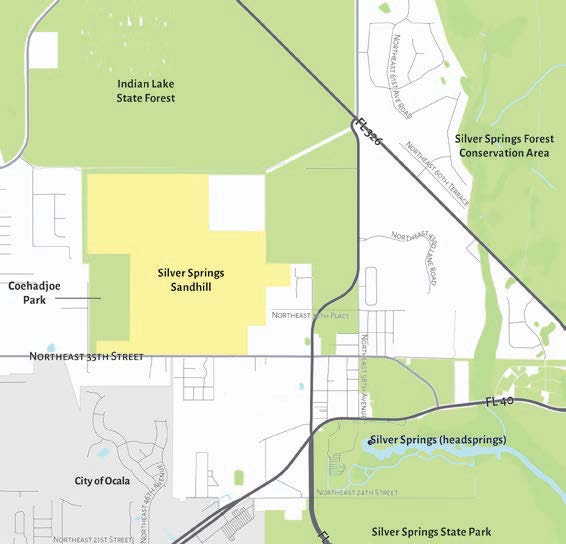
This year, we were thrilled to announce the protection of the 465-acre Silver Springs Sandhill property. In January, the Conservation Trust for Florida finalized negotiations and signed a purchase option with the property’s multiple owners. In September, the purchase was finalized with funding from Florida Forever, the state’s primary conservation land acquisition program. John Rudnianyn, one of the sellers, said, “This was the last large undeveloped property located in Silver Springs and was entitled for over 1,800 homes.” Instead of developing the property, which would have negatively impacted Silver Springs and the Silver River, the land is now in the hands of Marion County Parks and Recreation and will be opened to the public. As you can see in the map below, the property connects to Indian Lake State Forest and Marion County’s Coehadjoe Park.
“This was the last large undeveloped property located in Silver Springs and was entitled for over 1,800 homes.”


Springtime in the Forest
There’s nothing like a hike in the woods with friends…
By Cyndi Fernandez, CTF Assistant Director
There’s nothing like a hike in the woods with friends to ease some of the stress and worry of our hectic lives. I had the good fortune to spend some time with a few of your fellow CTF supporters earlier this year at the Silver Springs Forest Conservation Area, and I remember it like it was yesterday.
We couldn’t have wished for a more picture-perfect spring day. Gathered at the parking area off SR 326, an enthusiastic group of nine huddled over JB Miller’s LIDAR map. After much scientific chatter about the hydrogeologic characteristics of the property, Guy Marwick, an ardent environmentalist, brought us back to the reason we were all there – “Let’s walk,” he said.
With that, we hit the trail. As we ambled down a shady dirt road built atop an old railroad grade, the native plant experts among us called out the names of nearby trees. “That’s sweet gum,” chimed CTF intern Emily Hesterman, “… the one with star shaped leaves.” The facts fluttered like a passing swallowtail butterfly. It’s kind of a “weedy tree.” Its amber resin is medicinal. That’s swamp chestnut oak. “It’s a gorgeous tree with big acorns that are tasty to wildlife.”
We all stopped to inspect a high-tech well on the side of the trail. A solar-powered gizmo on top of the well transmits data to scientists at the St. Johns River Water Management District (District). It is one of many such wells used to monitor the level of water in the Floridan Aquifer.
JB, a land resource specialist with the District, led the group. He pointed out the box culverts (aka water cannons) jetting out of deep trenches on either side of the road. Water can gush through them after a rain event at high rates. Flow rates of up to 90+ cubic feet per second have been recorded at the State Road 40 bridge in the last couple of years. He said that’s “about like a first-magnitude spring.”
Naturalists Marcie Clutter and Jim Buckner kept the native plant name game going. The diverse hammock contained a dizzying array of plants with fantastical names – ironwood, dragonwood, crookedwood, devil- wood, innocence, resurrection fern, sparkleberry, deer tongue.
When Jim spotted a passerine nest that he determined had been modified by an arboreal golden mouse, I was sure these were either the most observant naturalists I’d ever met, or they were totally messing with me.
Either way, it was easy to daydream about a time when such an intimate knowledge of nature was integral to our survival.
We paused to admire a lovely oak branch that crossed the path. We marveled at the brilliant green of the spring leaves shimmering overhead. We walked along the dry creek bed, and Emily told us everything we ever wanted to know about frogs.
We made one final stop to see a huge cypress tree before parting ways. It was a wonderful morning. The group’s knowledge, good humor, and passion for protecting our natural world gives me hope for the future. I hope you’ll join us in the future when we venture out onto other lands that CTF has helped protect.

Bud Adams 1926 – 2017: A pragmatic visionary
When it came to conservation, Bud Adams thought not in terms of years but in terms of generations.
When it came to conservation, Bud Adams thought not in terms of years but in terms of generations.

Photo by Randy Batista
“The future of all of us lives in the conservation of our lands, water, and air.”
Most of us can only imagine “Old Florida” but Bud Adams wrote the book on it. In his book “The Old Florida,” he recounts the details of his life and shares his wisdom. He was a Florida Cattleman through and through.
He was also a conservationist. He saw it as his duty to care for his land along with the plants, animals, and people that depended on it. He took special care of employees, treating them like family, “only better.” He bred cattle that thrived in the harsh Florida environment rather than destroying the land to support the herd. He also led the way in protecting thousands of acres of the Adams Ranch before his passing.
When it came to conservation, he thought not in terms of years but in terms of generations. “In 50 or 100 years, we are going to need green space, a clean watershed, clean air, and a food supply. We must act now.”
Lisa Gearen remembers a visit she had with Bud in 2015: “A highlight was a ride we took out on the Fort Pierce property, which is also the site of the family homestead. Bud drove us in his pickup truck over land that he knew so intimately, talking passionately about its history and his stewardship.”
We will always be grateful to Bud Adams for his lifelong love of his “Old Florida,” his generous support of CTF, and for working with us to help his family place agricultural easements on portions of the Adams Ranch. We mourn his passing.

CTF Project: Pelaez & Sons Ranch offers refuge for wildlife
The Pelaez & Sons project exemplifies the relationship between sustainable agriculture and conservation.

Ralph Pelaez with his grandson McKinley on their 1,375-acre ranch in Okeechobee County. Photo by Randy Batista
The Conservation Trust for Florida worked with the Pelaez family to place a conservation easement on their 1,375- acre cattle ranch. The easement allows the family keep their land in agricultural production and protects important habitat near the Everglades Headwaters. This project was funded by the Department of Agriculture and Consumer Services and supported by the Florida Forest Service.
Located east of the Kissimmee River and eight miles north of Lake Okeechobee, the property is in a key location for watershed protection. It is adjacent to a federal wetlands reserve program easement and is near South Florida Water Management District conservation lands.
The property contains suitable habitat for many species such as the Eastern indigo snake, crested caracara, sandhill crane, gopher tortoise, Sherman’s fox squirrel, bald eagle, Southeastern American kestrel, burrowing owl, wood stork, and Florida grasshopper sparrow.
The Pelaez & Sons project exemplifies the relationship between sustainable agriculture and conservation. Funding from Florida’s Rural and Family Lands Protection Program has allowed this family to continue ranching while protecting important water resources and wildlife habitat.

CTF hires new leadership, creates new staff position
“Traci’s policy and advocacy work combined with her nonprofit leadership experience, love of Florida, and boundless energy is exactly what CTF and the conservation movement in Florida needs right now,” said Lisa Gearen, CTF’s president of the board.
GAINESVILLE, Fla. (Sept. 21, 2017) The Conservation Trust for Florida, a leader in statewide conservation, announced the addition of Traci Deen, as executive director and Butch Parks as director of conservation.
“I am honored to lead the Conservation Trust for Florida team during this exciting and challenging time for conservation,” Deen said. “Protecting Florida’s wild and working lands has never been more important, and CTF will play a key role in shaping Florida’s conservation future.”
Deen comes to CTF with a background in environmental law and policy, legislative analysis, and community outreach.. She also teaches as an adjunct professor at Barry University’s School of Law.

“Traci’s policy and advocacy work combined with her nonprofit leadership experience, love of Florida, and boundless energy is exactly what CTF and the conservation movement in Florida needs right now,” said Lisa Gearen, CTF’s president of the board.
After an exhaustive search that lasted four months, Deen emerged as the top candidate from a pool of over 100 applicants. A sixth generation Floridian, Deen is an environmental lawyer, member of the Florida bar, and actively engaged in her community by serving in numerous leadership roles. She serves as the Chair-Elect of the Junior Leagues of Florida Public Affairs Committee, and the legislative chair for both the Florida Association for Women Lawyers and the Central FL Women Lawyers Association. Additionally, she serves as a board member of AMIKids Orlando and the Salvation Army of Seminole County. She is also very involved in Florida’s environmental community, with a passion for protecting its landscapes for future generations.
The Conservation Trust for Florida is advancing a vision that creates a vast network of hubs and corridors to support wildlife populations, provide nature-based recreation and tourist activities, help maintain Florida’s cultural heritage and history, contribute to the availability of clean water and locally-grown food.
To help escalate the pace of land protection and achieve its ambitious vision, CTF added a new conservation director position, which has been filled by Butch Parks.
Parks comes to CTF from the Jackson Hole Land Trust (JHLT) in Wyoming, where he worked as regional lands director protecting crucial open space in the Greater Yellowstone Ecosystem. Prior to working for JHLT, Parks served as the commercial property manager for Wyoming State Lands and then as the land administration supervisor for the Wyoming Game and Fish Department.

Originally from Houston, Texas, Parks graduated from the University of Houston with a B.S. in electrical engineering technology. He has a diverse background in business ownership and management including ranching, aviation, veterinary medicine, construction, renewable energy, and real estate. Parks holds an Airline Transport Pilot Certificate, Flight Instructor Certificate, and is a licensed real estate broker. He also served honorably in the Marine Corps.
“I am excited to join CTF to conserve the wonders of Florida,” Parks said, “and I look forward to learning about Florida’s unique habitats and ecosystems and working with conservation partners throughout the state.”
I look forward to helping CTF conserve the wonders of Florida and working with conservation partners throughout the state.
CTF will use his knowledge of land acquisition, land management, conservation easements and government conservation programs to focus on landscape scale conservation projects, strategic partnerships, and new conservation programs throughout Florida.
“We are so fortunate to add Butch to our team. The depth and breadth of his knowledge of conservation is outstanding,” Gearen said. “With these new hires, CTF is growing to meet the demand for its services and address some of the critical conservation challenges we face as a state.”

Gearen added that CTF’s search committee and board played a crucial role in the successful hiring of these two, key staff members who will join CTF’s assistant director, Cyndi Fernandez, and its conservation consultant, Keith Fountain, in carrying out the organization’s mission to work with landowners to save Florida’s wild and working landscapes for future generations.
I have always believed in the edits of CTF’s mission. I am fortunate to be part of it.
– Cyndi Fernandez
To-date, the Conservation Trust for Florida has protected more than 19,000 acres. And over the last year, it has been instrumental in protecting over 6,500 acres including the Pelaez and Sons Ranch and the Adams Ranch near the Everglades headwaters and the Silver Springs Sandhillproperty in Central Florida.
CTF is a nonprofit land conservation organization that is accredited by the Land Trust Accreditation Commission and has met national quality standards in areas of finance, ethics, governance, and stewardship.
“We are proud of what we’ve accomplished and the momentum we’re building,” Gearen said. “The future looks bright.”
CTF Project: 465-acre property fills conservation gap in Ocala
In January, the Conservation Trust for Florida finalized negotiations and signed a purchase option with the multiple owners of the Silver Springs Sandhill site.
GAINESVILLE, Fla., Sept. 19, 2017 — The Conservation Trust for Florida, a leader in statewide conservation, announced the closing of the 465-acre Silver Springs Sandhill project in Ocala.
“This is the last large undeveloped property located in Silver Springs and was entitled for over 1,800 homes,”
said John Rudnianyn, real estate broker and part owner of the property.
“Originally the brainchild of Stan McClain, then chairman of the Marion County Commission and now a state representative, the purchase was masterfully negotiated and coordinated by the Conservation Trust for Florida and presented as the Silver Springs Sandhill project by Jim Couillard, Marion County Parks Director. This was indeed a public/private effort by Marion County Commissioners, Conservation Trust for Florida, The Florida Department of Environmental Protection and three landowners who felt the benefit to Silver Springs and recreation opportunities for Marion County residents far outweighed the allure of developing homes less than a mile from the main spring,” Rudnianyn explained.
In January, the Conservation Trust for Florida finalized negotiations and signed a purchase option with the multiple owners of the Silver Springs Sandhill site. In 2015, the land trust negotiated a similar deal with Rayonier and the St. Johns River Water Management District to protect the 4,900-acre Silver Springs Forest Conservation Area in Marion County.
“We are very proud of our work in the Silver Springs watershed,” said Lisa Gearen, president of the Conservation Trust for Florida. “We appreciate the partnerships with Marion County and the Florida Department of Environmental Protection that made this project possible, and it complements the conservation and recreation value of the adjacent 4,900-acre Silver Springs Forest Conservation Area, a CTF project completed in 2015 with the St. Johns River Water Management District. Projects that protect the health of Florida’s springs are among our highest priorities, and we look forward to future projects in the region.”
“Marion County is thrilled that this acquisition project has now been completed,” said Carl Zalak III, Chairman of the Marion County Board of County Commissioners. “We are grateful for the state’s decision to acquire this 465-acre area and look forward to managing the site in alignment with the county’s springs protection goals and our vision for an ever-growing outdoor recreation program.”
Silver Springs Sandhill is a crucial piece of Central Florida’s larger conservation puzzle. The property adds to a protective buffer around the iconic Silver Springs — one of the largest artesian spring systems in the world. The property also connects to Indian Lake State Forest and Marion County’s Coehadjoe Park.
In addition to benefiting water quality and quantity, the site will offer public recreation opportunities and contribute to Ocala’s growing popularity as an ecotourism destination.
Central Florida is becoming one of Florida’s largest conservation hubs, where an estimated 500,000 acres of connected, publicly-owned conservation lands entice visitors and protect springs, rivers, groundwater and wildlife.
The property was acquired with funding from the Florida Forever program.

CTF Earns National Recognition
GAINESVILLE, Florida (August 10, 2017) –
At a time of political change, one thing is clear and consistent: Floridians strongly support saving the open spaces they love. Since 1999, the Conservation Trust for Florida has been doing just that.
Now the Conservation Trust for Florida has renewed its land trust accreditation – proving once again that it is committed to professional excellence and to maintaining the public’s trust in its conservation work.

“The accreditation seal is a symbol of professionalism, dedication and integrity. Working through the reaccreditation experience has made us stronger and the achievement conveys CTF’s commitment to upholding the highest standards for land conservation,” said Lisa Gearen, president of the Conservation Trust for Florida.
To achieve this national distinction, the Conservation Trust for Florida had to provide extensive documentation and undergo a comprehensive review as part of its accreditation renewal. The Land Trust Accreditation Commission awarded the renewed accreditation, signifying its confidence in the Conservation Trust for Florida’s long-term stability.
Accredited land trusts must renew every five years, confirming their compliance with national quality standards and providing continued assurance to donors and landowners of their commitment to forever steward their land and easements. Almost 20 million acres of farms, forests and natural areas vital to healthy communities are now permanently conserved by an accredited land trust.
Over the last five years, the Conservation Trust for Florida has been instrumental in protecting over 10,000 acres. Working with partners, foundations, citizens and landowners, we continue to lead statewide conservation projects totaling over 165,000 acres. Notable successes include the 5,000-acre Silver Springs Forest Conservation Area in Central Florida, now owned by the St. Johns River Water Management District and the protection of thousands of acres of historic ranchlands near the Everglades Headwaters.
“It is exciting to recognize the Conservation Trust for Florida with this distinction,” said Tammara Van Ryn, executive director of the Commission. “Accredited land trusts are united behind strong ethical standards ensuring the places people love will be conserved forever. Accreditation recognizes the Conservation Trust for Florida has demonstrated sound finances, ethical conduct, responsible governance, and lasting stewardship.”
Accreditation Statistics
The Conservation Trust for Florida was first accredited in 2012. It is one of 1,363 land trusts across the United States according to the most recent National Land Trust Census, released December 1, 2016 by the Land Trust Alliance. This comprehensive report also shows that accredited land trusts have made significant achievements.
- Accredited land trusts have steadily grown and now steward almost 80% of conservation lands and easements held by all land trusts.
- Accredited land trusts protected five times more land from 2010 to 2015 than land trusts that were not accredited.
- Furthermore, accreditation has increased the public’s trust in land conservation, which has helped win support for federal, state and local conservation funding measures.
The Conservation Trust for Florida is one of only five accredited land trusts in the state of Florida and one of only 389 accredited land trusts across the nation. A complete list of accredited land trusts and more information about the process and benefits are detailed at www.landtrustaccreditation.org.
About the Conservation Trust for Florida
The Conservation Trust for Florida, Inc. is a 501 (c)(3) non-profit land trust. The mission of CTF is to work with landowners to save Florida’s wild and working landscapes for future generations. CTF works with landowners whose properties are located within a network of conservation priority areas to implement projects that protect agricultural, wildlife and water resources.
About the Land Trust Accreditation Commission
The Land Trust Accreditation Commission inspires excellence, promotes public trust and ensures permanence in the conservation of open lands by recognizing organizations that meet rigorous quality standards and strive for continuous improvement. The Commission, established in 2006 as an independent program of the Land Trust Alliance, is governed by a volunteer board of diverse land conservation and nonprofit management experts. For more, visit www.landtrustaccreditation.org.
About the Land Trust Alliance
Founded in 1982, the Land Trust Alliance is a national land conservation organization that works to save the places people need and love by strengthening land conservation across America. Based in Washington, D.C., and with several regional offices, the Alliance represents about 1,000 member land trusts nationwide.
The Alliance’s leadership serves the entire land trust community—our work in the nation’s capital represents the policy priorities of land conservationists from every state; our education programs improve and empower land trusts from Maine to Alaska; and our comprehensive vision for the future of land conservation includes new partners, new programs and new priorities. Connect with us online at www.landtrustalliance.org.

CTF Project: 4th Adams Ranch easement protects 3,245 acres
We are proud to announce the protection of 3,245 acres of conservation and ranch lands in Osceola County.
GAINESVILLE, Florida (July 31, 2017) – Today, the Conservation Trust for Florida (CTF), a leader in statewide conservation, announced the protection of 3,245 acres of conservation and ranch lands in Osceola County.
The property contains over 400 acres of rare dry prairie habitat suitable for the federally endangered grasshopper sparrow. Other significant natural areas include, wetland prairie, marsh, freshwater forested wetland, unimproved pasture and mixed scrub habitats.

Adams Ranch, Photo by Randy Batista
The project also supports Florida’s ranching heritage and agriculture industry. According to the Florida Cattleman’s Association, Florida is the nation’s oldest cattle ranching state and ranks in the top 15 for production.
A conservation easement will allow the land to stay in private ownership while permanently protecting its conservation values. The easement was purchased by the Florida Department of Agriculture and Consumer Services (DACS) for $5.4 million. The Florida Forest Service will monitor the property to ensure compliance with the terms of the easement.
“This is the 30th easement on over 28,400 acres that the program has acquired since 2010 on behalf of the Trustees of the Internal Improvement Trust Fund of the State of Florida,” said John Browne, land programs administrator with DACS’s Rural and Family Lands Protection Program. “It continues our tradition of sustaining family-owned agricultural properties that also provide significant value to Florida’s large conservation landscapes.”
Conservation easements are voluntary, legal agreements between a landowner and a land trust or government agency that protect conservation values and existing land uses. Landowners may continue to own and use land as permitted by the easement, sell it, donate it, or pass it on to heirs. If the land is inherited or sold the easement and its restrictions stay in place.
Owned by the Adams Ranch, which has been in operation since the 1930s, the property is the fourth parcel the Adams family has placed under a conservation easement.
Mike Adams, president of the Adams Ranch, said that the 24,000-acre ranch has been in his family for four generations. “This is our third time working with CTF, which has played a pivotal role in protecting the land that our entire family, and especially our father, Bud Adams, holds dear.”
“With this closing, CTF will have helped the Adams protect 5,443 acres of their ranch over the last three years. I can think of no other legacy that honors the life and work of Bud Adams better than this, and CTF is proud and grateful to be a part of that,” added Lisa Gearen, CTF’s president.”
CTF prepared the application for the Rural and Family Lands Protection Program, facilitated the appraisal process and easement negotiations, and helped the family navigate the complexities of the transaction.
The Adams Ranch is the 12th largest cow/calf operation in the United States. This latest easement is on their Lake Marian Ranch that lies in the heart of the Everglades Headwaters National Wildlife Refuge and Conservation Area. The Refuge seeks to protect the imperiled habitats and rare species of the Northern Everglades.
According to data from the Florida Natural Areas Inventory, a non-profit organization administered by Florida State University, the property contains suitable habitat for a number of state and federally endangered species. A partial list of species that could be supported by habitat on the site includes: gopher tortoises, Eastern indigo snakes, Everglades snail kites, Florida burrowing owls, Florida Sandhill cranes, Florida grasshopper sparrows, Sherman’s fox squirrels and Florida black bears.

CTF Helps Ranching Family Save 1,375 Acres Near Kissimmee River and Lake Okeechobee
We are pleased to announce the protection of a 1,375-acre cattle ranch in Okeechobee County.

Ralph Pelaez with his daughter, Stephanie Pelaez and grandson McKinley on their 1,375-acre ranch in Okeechobee County. Photo by Randy Batista.
Gainesville, Florida (May 1, 2017) – The Conservation Trust for Florida (CTF), a leader in statewide conservation, announced the protection of a 1,375-acre cattle ranch in Okeechobee County.
A conservation easement, purchased by the Florida Department of Agriculture and Consumer Services (DACS) for $3.25 million, now permanently protects the land’s natural resources and sustains the Peleaz & Sons’ agricultural operation.
“This is the 29th easement on over 21,265 acres that the program has acquired since 2010 on behalf of the Trustees of the Internal Improvement Trust Fund of the State of Florida and continues our tradition of sustaining family-owned agricultural properties that also provide significant value to Florida’s large conservation landscapes,” noted John Browne, Land Programs Administrator with DACS's Rural and Family Lands Protection Program.
CTF's role
The Conservation Trust for Florida helped the landowner navigate the transaction process, provided real estate expertise and facilitated the easement purchase. The Florida Forest Service will monitor the property to ensure compliance with the terms of the conservation easement.
Pelaez & Sons history
The Pelaez & Sons cow/calf ranch has been in continuous operation since the 1950s when Abel Pelaez came to the United States from Colombia. His son, Ralph Pelaez, now owns the land where he and his family use best management practices to raise their cattle.
“My family has always been committed to ranching and the conservation of this land,” said Pelaez. “I am very grateful to the Conservation Trust for Florida and the Rural and Family Lands Program for helping me establish this legacy for my children and grandchildren.”
Their ranching operation is a model and is visited annually by the University of Florida beef production class for educational purposes.
In addition to its agricultural features, the property has high conservation value. Ecological communities include pastureland, wet prairie, prairie hammock and freshwater marsh.
Conservation values
Located east of the Kissimmee River and eight miles north of Lake Okeechobee, the property is in a key location for watershed protection. It is adjacent to a federal wetlands reserve program easement and is near South Florida Water Management District conservation lands.
It is also home to, and contains suitable habitat for, many species such as the Eastern Indigo snake, Crested Caracara, Sandhill Crane, Gopher Tortoise, Sherman’s Fox Squirrel, Bald Eagle, Southeastern American Kestrel, Burrowing Owl, Wood Stork, and Florida Grasshopper Sparrow.
What is a conservation easement?
Conservation easements are voluntary, legal agreements between a landowner and a land trust or government agency that protect conservation values. Landowners may continue to own and use land, sell it, donate it, or pass it on to heirs, but the easement ‘runs with the land.’ If the land is inherited or sold the easement and its restrictions stay in place.
CTF Project: Cabinet approves purchase of 365 acres in Marion County
“This is exactly the kind of project that we love. It brings together partners around a common goal and truly enhances the conservation value of surrounding lands. It’s exciting to be part of this success and partner with local government.”
The Conservation Trust for Florida announced today a second land conservation victory in Marion County. Thanks to today’s approval by Governor Rick Scott and the Florida Cabinet, 365 acres in Ocala will be acquired with funding from the Florida Forever program.
The site, known as Silver Springs Sandhill, will be purchased by the state and managed by Marion County Parks and Recreation. The application to Florida Forever was submitted by Marion County.
In January, the Conservation Trust for Florida finalized negotiations and signed a purchase option with the multiple owners of the Silver Springs Sandhill site, which was slated to be developed with 1600 housing units. The option will now be assigned to the state and the purchase will be completed later this year. In 2015, the land trust negotiated a similar deal with Rayonier and the St. John’s River Water Management District to protect the 4,900-acre Silver Springs Forest Conservation Area in Marion County.
Silver Springs Sandhill is a crucial piece of Central Florida’s larger conservation puzzle. The property adds to a protective buffer around the iconic Silver Springs — one of the largest artesian spring systems in the world. The property also connects to Indian Lake State Forest and Marion County's Coehadjoe Park.
As its name implies, the property’s soil is sandy, making it an excellent aquifer recharge site. In addition to benefiting water quality and quantity, the site will offer public recreation opportunities and contribute to Ocala’s growing popularity as an ecotourism destination.
Central Florida is becoming one of Florida’s largest conservation hubs, where an estimated 500,000 acres of connected, publicly-owned conservation lands entice visitors and protect springs, rivers, groundwater and wildlife.
Lisa Gearen, president of the Conservation Trust for Florida’s board of directors said, “This is exactly the kind of project that we love. It brings together partners around a common goal and truly enhances the conservation value of surrounding lands. It’s exciting to be part of this success and partner with local government. We expect to be doing more of that in the future.”